Fiber Broadband in Block B, Freedom Fighter Enclave is not only a question about advertised speed. It is a question about whether the fiber route reaches the premises, where the broadband router will sit and how the broadband link behaves when multiple networked devices are active.
Properties around Freedom Fighter Enclave often combine living and working spaces. A bedroom can also be a home office, a ground floor can be a shop, and upper floors can be rented separately; the network must therefore be stable, secure and easy to extend.
Before choosing a connection in Freedom Fighter Enclave
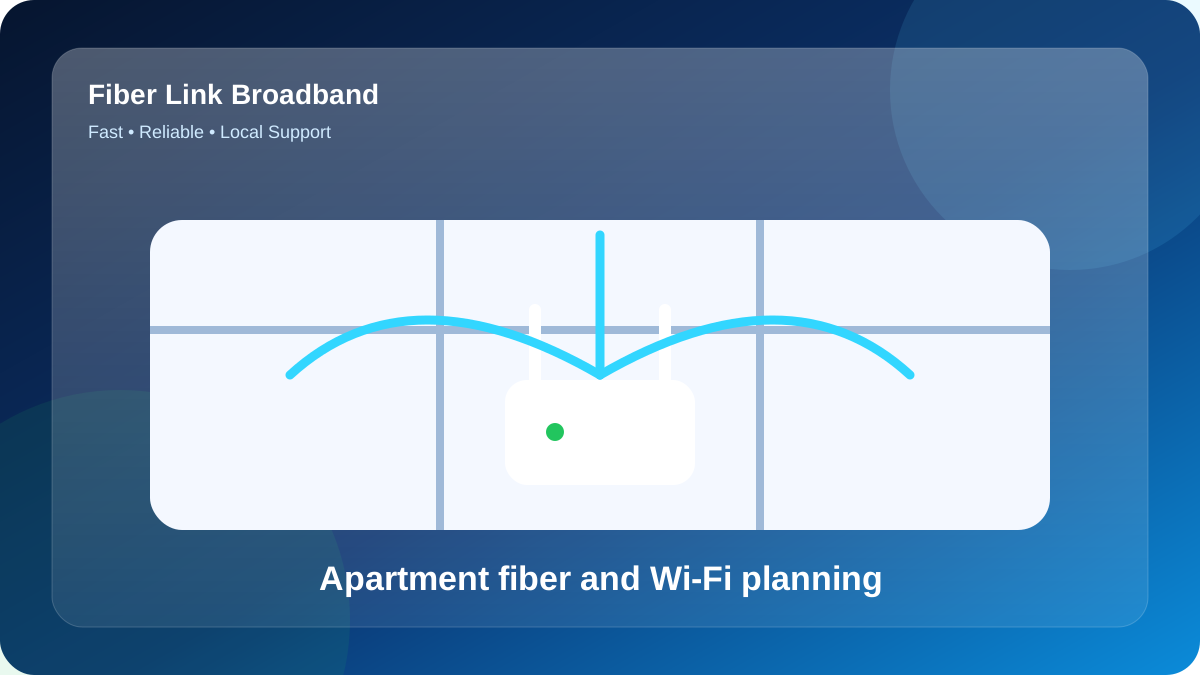
This planning point matters because the area includes builder floors and multi-storey houses where one router may not cover every bedroom, balcony and upper floor evenly. Ahead of the setup, decide which room needs the strongest signal, whether the broadband router can be placed centrally and whether a second access point may be required. This prevents the common mistake of placing the broadband router beside the fiber entry only because it is convenient for the cable.
Nearby reference points such as Neb Sarai, Paryavaran Complex and IGNOU Road help describe the service pocket, but a landmark is not a substitute for the Block B service location. Two buildings on the same road can have different access paths, permissions or internal wiring conditions.
Freedom Fighter Enclave is best approached through a premises-level coverage verification. The broad area may be serviceable while an individual lane, block, floor or building still needs confirmation of the nearest distribution point and a safe cable route. Sharing the house number, floor, landmark and a map pin helps the installation team avoid vague promises.
How to get better results at Block B
When arranging service for a specific property such as Block B, first confirm who can approve the cable route and where the fiber termination box can be fixed. In a rented flat, the tenant may need the owner’s permission for drilling; in a shared building, the route should avoid stairway hazards and exposed bends.
For Block B, vertical coverage deserves its own design. Concrete slabs can block wireless signals, so a cable-connected access point on the active floor is often the cleanest solution.
Before activation at Block B, confirm whether the service is for one household or for separately occupied floors. Guest Wi-Fi, distinct routers and labelled power adapters can simplify privacy and maintenance.
A realistic usage example for Block B
A realistic Block B example uses a home office with a connected television and CCTV for society residents, professionals and tenants. Peak demand can include two camera calls, one 4K TV, four phones and cloud backup.
A 200 Mbps plan with a centrally placed dual-band router would usually be the balanced starting point. If the service location spans floors, budget for a hard-wired wireless node rather than expecting the primary router to cross every slab.
A sound recommendation for Block B states why the chosen speed and layout fit the usage. Generic “best plan” claims are not enough.
Network load model for this Freedom Fighter Enclave address
For this guide, consider a planning model with 2 main rooms across 1 floor level, approximately 3 phones, 4 laptops, 2 smart TVs and 1 camera. This is not a claim about the actual property at Block B; it is a practical load model that helps a customer count devices before selecting a plan.
In the model for Block B, the morning load is cloud backup and WhatsApp calls, while the busiest evening period begins around 6:00 PM with gaming while another user watches 4K content. Because the activities overlap, the recommendation should include headroom for background data demand. A phone can upload photos, a television can update apps and a camera can send data even when nobody is actively thinking about bandwidth.
The first router candidate for Block B should be near the reception desk, with a second test position near the shop counter. The main obstacle in this example is a reinforced concrete wall. Instead of fixing the broadband router immediately beside the optical entry point, compare both candidate positions using the same phone, the unchanged testing server and the same Wi-Fi band.
The indoor zone sequence for testing this Freedom Fighter Enclave setup is reception desk, then rear bedroom, then shop counter, and finally TV wall. Record signal strength or practical speed at each point. The unusual order is intentional: it checks one nearby zone, one difficult zone, another normal zone and the far edge, which makes the coverage pattern easier to interpret.
For Block B, an upgrade from 100 to 200 Mbps is justified when overlapping user demand create congestion near the gateway. An access point or mesh upgrade is justified when the speed is healthy near the Wi-Fi unit but falls sharply in rear bedroom or TV wall. These are different symptoms and should not be solved with the same purchase.
A useful diagnostic note for Fiber Broadband in Block B, Freedom Fighter Enclave should say which device was used, whether it was connected by Ethernet, 5 GHz or 2.4 GHz, the indoor zone, the test time and the broadband router light status. “Slow internet” is difficult to diagnose; “5 GHz is normal in reception desk but weak in TV wall after 6:00 PM” gives the technician a starting point.
| Zone | Purpose | Recommended check | Decision |
|---|---|---|---|
| reception desk | Close-range baseline | Use as the comparison point | Plan Ethernet backhaul when Block B spans weak zones |
| shop counter | Family-use zone | Compare signal before drilling | Plan Ethernet backhaul when Block B spans weak zones |
| rear bedroom | Wall-crossing test | Do not upgrade speed first | Keep current layout |
| TV wall | Edge of coverage | Plan Ethernet for fixed equipment | Keep current layout |
Capacity worksheet for Block B
The Block B capacity exercise begins at the busiest household window, approximately 7:00 PM in this model. Count 7 simultaneous clients, of which 1 are fixed screens, 8 are mobile or laptop devices and 1 are handling live calls. Replace these sample counts with the real property figures.
The example load at Block B combines remote desktop, large file transfer and multiplayer gaming. If these overlap with software updates, watch whether performance falls even beside the broadband router. Congestion near the gateway points toward capacity; weakness only in another room points toward coverage.
Test the worksheet in this order: study desk for the baseline, TV area for normal use and shop counter for the edge case. Keep the client device and server unchanged. If study desk is strong but shop counter is weak, improve the indoor network; if all three are weak at the same time, investigate service capacity or line quality.
| Example load | Main activity | Priority | Planning action |
|---|---|---|---|
| 1 fixed screen | remote desktop | High | Avoid weak repeater paths |
| 8 mobile/laptop devices | large file transfer | Variable | Distribute across both Wi-Fi bands |
| 1 live call | multiplayer gaming | High | Pause bulk transfers during critical calls |
| 7 total active clients | software updates | Combined demand | Retest at the busiest hour |
Fiber plans from ₹499 explained
Speed selection should be based on people and activities rather than the number of phones saved on the broadband router. Background updates, smart TVs and cameras also consume capacity.
| Speed | Price | Typical fit | Suitable uses |
|---|---|---|---|
| 100 Mbps | ₹499/month | Budget-focused connection | Everyday apps on a few devices |
| 200 Mbps | ₹699/month | Balanced household choice | Concurrent streaming and meetings |
| 300 Mbps | ₹799/month | Maximum headroom | Busy homes with many active devices |
The 100 Mbps plan can be a strong entry choice for one room, a small family or users who mainly browse, study and stream in HD. It will not improve weak coverage by itself, so Wi-Fi gateway position still matters.
The 200 Mbps tier is the balanced option for many Freedom Fighter Enclave households. It gives more room for several phones, a connected television, meetings and downloads to run together without one activity immediately affecting another.
At 300 Mbps, the broadband link can absorb busy household traffic more comfortably. However, a dead zone remains a dead zone until the Wi-Fi design is fixed; higher Mbps does not pass through concrete more easily.
From availability check to activation
Use this process to move from enquiry to a tested, secure connection.
- Provide the complete property details: Send the house or shop number, floor, Freedom Fighter Enclave landmark and a map pin on WhatsApp. Mention whether the service location is owned or rented.
- Select the appropriate Mbps tier: Choose 100, 200 or 300 Mbps using the number of overlapping user demand, not only the lowest price or largest headline speed.
- Check full-fiber serviceability: The local installation crew checks whether an active route and safe cable path are available for the premises. Any special internal cabling should be discussed before work starts.
- Agree on Wi-Fi gateway position: Identify the indoor zone where coverage matters most. A slightly longer internal cable can be worthwhile when it places the broadband router centrally.
- Test and secure the network: Following activation, test near the Wi-Fi unit, set a strong Wi-Fi password, change the admin password and check the main rooms.
At Block B, reject any route that crosses walking areas or forces the fiber into a tight corner. Confirm the termination point and leave a safe maintenance loop.
Speed, ping, upload and jitter explained
One result cannot describe Block B reliably. Compare a normal period with the busy period and save screenshots that identify time, equipment and whether Ethernet or Wi-Fi was used.
Read the Block B test as four separate signals: download for incoming data, upload for outgoing data, ping for responsiveness and jitter for stability. A smooth call may depend more on the last two.
At Block B, compare a cable test with a strong Wi-Fi test and then the distant room. Different results point toward different fixes instead of an automatic plan upgrade.
Router setup for stronger in-home performance
For Block B, use 2.4 GHz where reach is more important and 5 GHz where nearby speed is the priority. Distinct network names make band testing easier.
Test Block B in two zones before changing plans. A healthy close-range result followed by a poor far-room result means the indoor network needs redesign.
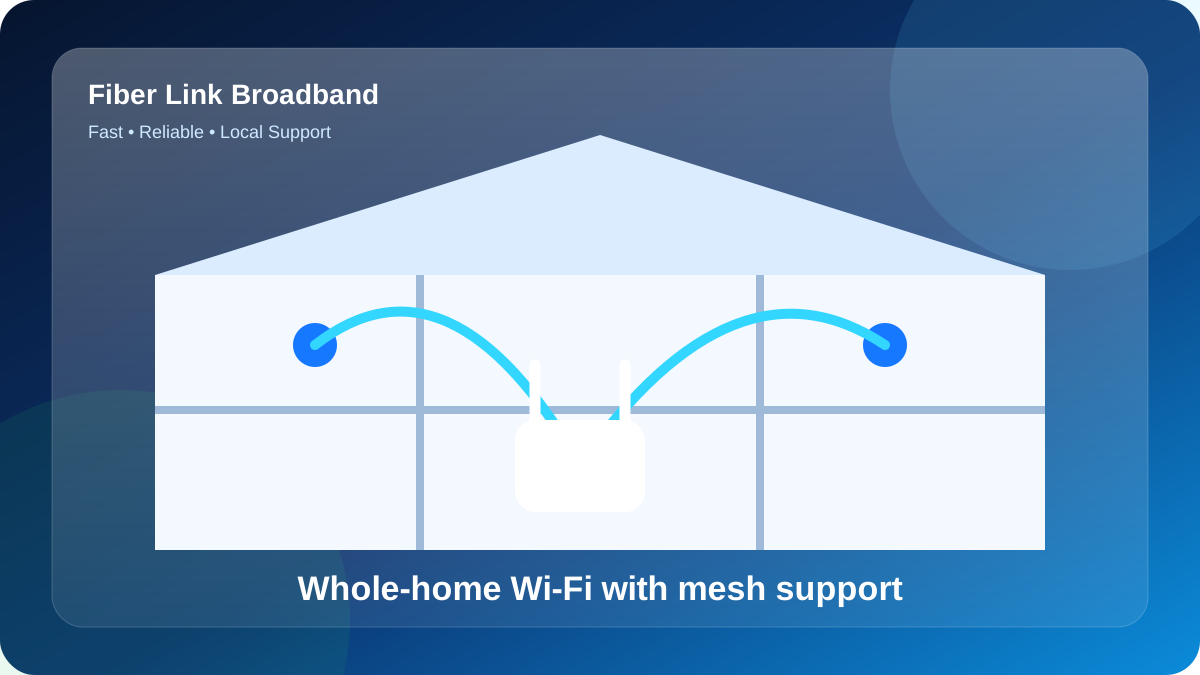
In Freedom Fighter Enclave, the area includes builder floors and multi-storey houses where one router may not cover every bedroom, balcony and upper floor evenly. For a second floor or a distant room, a hard-wired wireless node usually preserves more speed than a basic repeater. Mesh systems are convenient when wiring is difficult, but node placement must still be tested.
Troubleshooting playbook for Block B
Use the following page-specific fault example: at Block B, the broadband link becomes inconsistent only during the evening. The purpose is not to assume that every customer will see this problem, but to show a disciplined way to isolate it without repeatedly resetting equipment or changing several settings at once.
- Create a baseline: Test one modern device near the gateway with background downloads stopped.
- Change only one variable: Move to the trouble zone without changing the server, device or band.
- Inspect physical indicators: Check power, optical lights, connectors and sharp cable bends.
- Compare another device: A second device helps identify a phone or laptop problem.
- Send a complete report: Provide the time, room, band and results to 9971524677.
The best troubleshooting record for Fiber Broadband in Block B, Freedom Fighter Enclave is short but precise: normal result, failed result, room, device, band and time. This evidence helps decide whether remote guidance or a site visit is appropriate.
Security, cable care and reliable daily operation
Use WPA2/WPA3 and two distinct passwords at Block B: one for Wi-Fi and one for administration. For shared housing in Freedom Fighter Enclave, a guest network is useful for visitors and temporary tenants.
Block B should not need daily router restarts. Before rebooting repeatedly, note the optical lights, power condition, cable state and time of failure.
At Block B, label the router and optical-terminal adapters so they are not exchanged. A correctly sized mini UPS can keep both units running through brief cuts.
What to verify before making payment
A two-minute checklist can prevent confusion about cost, equipment and support later.
- Payment receipt and plan start date
- Rules for shifting the service to another nearby property
- Exact monthly fee and selected speed
- Special configuration needed by CCTV, business software or remote access
- Indoor wireless coverage needs across floors or distant rooms
- Router model, ownership or refundable security terms
- Expected setup work and optical-cable entry route
Check fiber availability for Block B
Send the exact Freedom Fighter Enclave address, floor and nearby landmark. Fiber Link Broadband will check feasibility and explain the suitable plan and Wi-Fi setup.
WhatsApp 9971524677FAQs about Fiber Broadband in Block B, Freedom Fighter Enclave
How do I request a new connection in PIN 110030?
Phone or WhatsApp 9971524677, share the complete address and choose a preferred plan. Feasibility, installation details, router terms and scheduling are then confirmed for the service location.
Does a faster plan improve Wi-Fi range?
No. Tier bandwidth increases available capacity, but range depends on Wi-Fi gateway position, band, walls and interference. A secondary mesh point or access point with Ethernet backhaul may be needed for distant rooms or another floor.
Which broadband speed is suitable for Block B?
At Block B, choose 100 Mbps for basic use, 200 Mbps for balanced multi-user activity, or 300 Mbps when heavy streaming, gaming and file movement overlap.
Can one router cover a multi-floor home?
Sometimes, but concrete floors often weaken the signal. A hard-wired wireless node or correctly placed secondary mesh point is usually more reliable than relying on one router at the fiber entry point.
How should I test broadband speed after installation?
First test with Ethernet or 5 GHz Wi-Fi near the gateway, then test the normal rooms. Stop downloads and VPNs during the test, and record ping, download, upload, device and time.