Broadband decisions are easier when the technical terms are converted into everyday outcomes. Here, Kapoor Residency Broadband is explained through real uses such as video conferences, OTT, CCTV, gaming, uploads and multi-device homes.
In this part of South Delhi, internet commonly supports cloud backup, smart TVs, UPI and billing, multiplayer gaming and video meetings. An internet service should be planned for simultaneous use rather than a single speed-test screenshot.
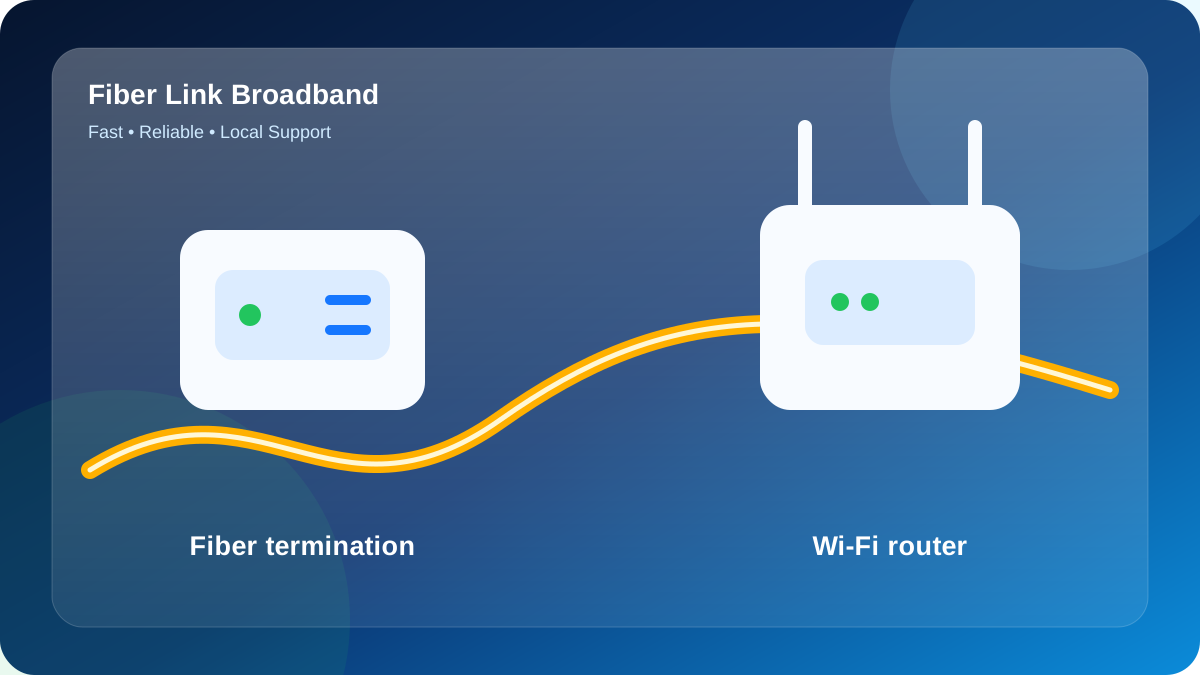
Before choosing a connection in Paryavaran Complex
This planning point matters because the area includes apartments and independent floors where the optical network entry point may be on a different level from the main Wi-Fi usage area. Ahead of the setup, decide which room needs the strongest signal, whether the broadband router can be placed centrally and whether a second access point may be required. This prevents the common mistake of placing the broadband router beside the fiber entry only because it is convenient for the cable.
Nearby reference points such as Said-ul-Ajaib, Freedom Fighter Enclave and Westend Marg help describe the service pocket, but a landmark is not a substitute for the Kapoor Residency service location. Two buildings on the same road can have different access paths, permissions or internal wiring conditions.
Paryavaran Complex is best approached through a property-specific route review. The broad area may be serviceable while an individual lane, block, floor or building still needs confirmation of the nearest distribution point and a safe cable route. Sharing the house number, floor, landmark and a map pin helps the installation team avoid vague promises.
100, 200 or 300 Mbps: choosing the right plan
Speed selection should be based on people and activities rather than the number of phones saved on the broadband router. Background updates, smart TVs and cameras also consume capacity.
| Speed | Price | Typical fit | Suitable uses |
|---|---|---|---|
| 100 Mbps | ₹499/month | Budget-focused connection | Everyday apps on a few devices |
| 200 Mbps | ₹699/month | Balanced household choice | Concurrent streaming and meetings |
| 300 Mbps | ₹799/month | Maximum headroom | Busy homes with many active devices |
Choose 100 Mbps when the address has a limited number of people online together and no constant large update files. It is a practical starting point, especially for tenants and compact homes.
For a family or shared flat, 200 Mbps provides useful headroom during the heavy-use evening period. It is also a sensible choice when a CCTV recorder, cloud backup or second TV stays online in the background.
Choose 300 Mbps for the largest headroom: several 4K screens, frequent game downloads, cloud work and many connected devices. A suitable dual-band router is important at this tier.
Practical advice for Kapoor Residency Broadband
When arranging service for a specific property such as Kapoor Residency, first confirm who can approve the cable route and where the fiber termination box can be fixed. In a rented flat, the tenant may need the owner’s permission for drilling; in a shared building, the route should avoid stairway hazards and exposed bends.
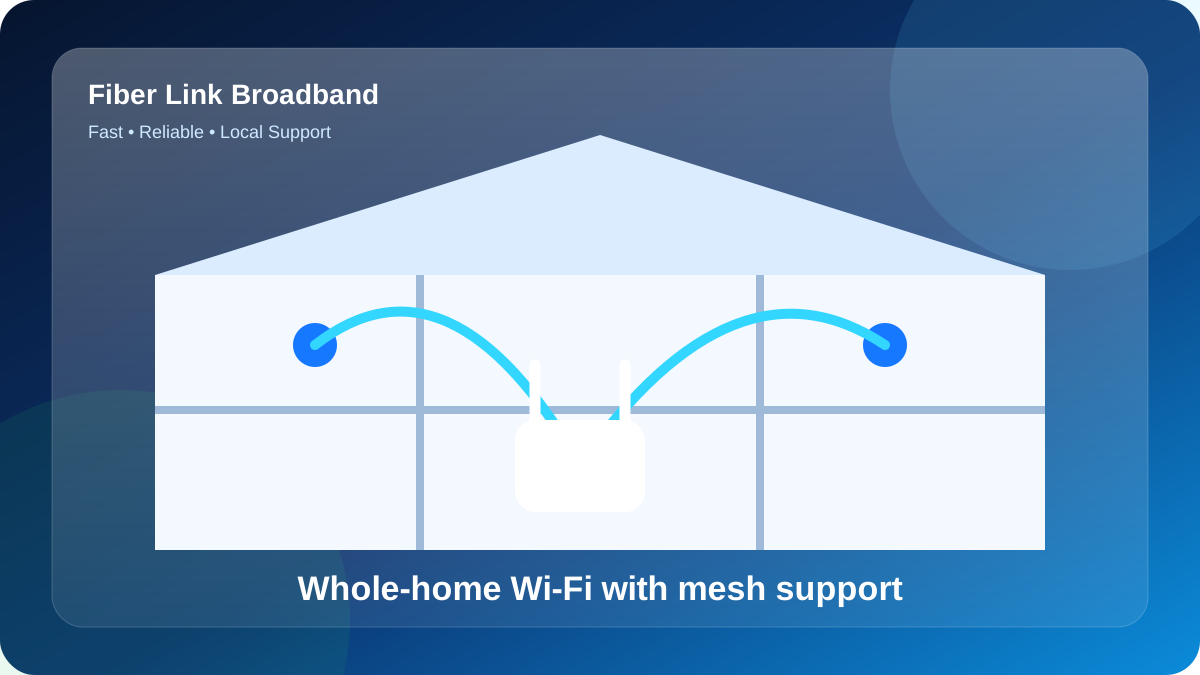
Do not assume one router will cross every level at Kapoor Residency. If usage is concentrated upstairs or downstairs, extend the network with Ethernet backhaul or a tested mesh position rather than adding a random repeater.
If Kapoor Residency contains multiple households, plan access boundaries instead of distributing one password without control. Separate wireless networks and simple equipment labels make the system easier to manage.
Five steps to install broadband
Use this process to move from enquiry to a tested, secure connection.
- Provide the exact building and floor: Send the house or shop number, floor, Paryavaran Complex landmark and a map pin on WhatsApp. Mention whether the building is owned or rented.
- Check local line availability: The local installation crew checks whether an active route and safe cable path are available for the structure. Any special internal cabling should be discussed before work starts.
- Match the package to demand: Choose 100, 200 or 300 Mbps using the number of people online together, not only the lowest price or largest headline speed.
- Agree on router positioning: Identify that area where coverage matters most. A slightly longer internal cable can be worthwhile when it places the broadband router centrally.
- Test and secure the network: After the line goes live, test near the Wi-Fi unit, set a strong Wi-Fi password, change the admin password and check the main rooms.
After the line goes live, save the Wi-Fi name, support number and payment details. Photograph the optical indicators when the active line is working normally; this can help describe a future fault.
5 GHz Wi-Fi, router placement and full-room coverage
Choose bands by purpose at Kapoor Residency: 5 GHz for high-speed nearby devices and 2.4 GHz for low-demand devices at greater distance. Label them clearly while diagnosing.
In Paryavaran Complex, the area includes apartments and independent floors where the optical network entry point may be on a different level from the main Wi-Fi usage area. For a second floor or a distant room, an Ethernet-fed access point usually preserves more speed than a basic repeater. Mesh systems are convenient when wiring is difficult, but node placement must still be tested.
At Kapoor Residency, separate fiber capacity from indoor Wi-Fi. Test 5 GHz in the main signal area, then repeat in the farthest used room; a large drop between them points to coverage.
Speed, ping, upload and jitter explained
For Kapoor Residency, run a controlled performance test: use one current device, pause heavy transfers, avoid a VPN and test by Ethernet or from the primary Wi-Fi zone. Keep the server unchanged for comparison.
Use a three-stage comparison at Kapoor Residency: Ethernet first, nearby 5 GHz second and the weak zone last. This separates line capacity from wireless distribution.
Repeat the Kapoor Residency measurement in two time windows. Record the device, room, band and connection method so support receives evidence rather than a general description.
A realistic usage example for Kapoor Residency
A realistic Kapoor Residency example uses a three-level family home for families, home offices and landlords. Peak demand can include two video conferences, one 4K TV, four phones and cloud backup.
Start by testing the main room and the far room separately. If capacity is sufficient near the Wi-Fi unit, improve coverage before upgrading the chosen package. This avoids paying more without fixing the actual weak spot.
The Kapoor Residency proposal is stronger when it explains both capacity and coverage instead of offering one standard answer.
Room-by-room planning notes for Kapoor Residency Broadband
For this guide, consider a planning model with 4 main rooms across 1 floor level, approximately 3 phones, 3 laptops, 1 connected television and no cameras. This is not a claim about the actual property at Kapoor Residency; it is a practical load model that helps a customer count devices before selecting a plan.
In the model for Kapoor Residency, the morning load is cloud backup and WhatsApp calls, while the busiest evening period begins around 6:00 PM with two OTT streams plus social video. Because the activities overlap, the recommendation should include headroom for unnoticed device usage. A phone can upload photos, a television can update apps and a camera can send data even when nobody is actively thinking about bandwidth.
The first router candidate for Kapoor Residency should be near the rear bedroom, with a second test position near the front bedroom. The main obstacle in this example is a metal storage unit. Instead of fixing the broadband router immediately beside the optical entry point, compare both candidate positions using the same phone, the unchanged testing server and the same Wi-Fi band.
That area sequence for testing this Paryavaran Complex setup is rear bedroom, then balcony workspace, then front bedroom, and finally upper-floor room. Record signal strength or practical speed at each point. The unusual order is intentional: it checks one nearby zone, one difficult zone, another normal zone and the far edge, which makes the coverage pattern easier to interpret.
For Kapoor Residency, an upgrade from 100 to 200 Mbps is justified when people online together create congestion in the primary wireless zone. An access point or mesh upgrade is justified when the speed is healthy near the Wi-Fi unit but falls sharply in balcony workspace or upper-floor room. These are different symptoms and should not be solved with the same purchase.
A useful technical support message for Kapoor Residency Broadband should say which device was used, whether it was connected by Ethernet, 5 GHz or 2.4 GHz, that area, the test time and the broadband router light status. “Slow internet” is difficult to diagnose; “5 GHz is normal in rear bedroom but weak in upper-floor room after 6:00 PM” gives the technician a starting point.
| Zone | Purpose | Recommended check | Decision |
|---|---|---|---|
| rear bedroom | Primary router candidate | Check 5 GHz speed and ping | Plan Ethernet backhaul when Kapoor Residency spans weak zones |
| front bedroom | Alternative router point | Check video-call stability | Review during peak time |
| balcony workspace | Coverage challenge | Move whole-home Wi-Fi node closer | Retest after repositioning |
| upper-floor room | Distant device zone | Plan Ethernet for fixed equipment | Review during peak time |
A practical demand worksheet for Kapoor Residency Broadband
Use this worksheet as a planning exercise for Kapoor Residency. Assume 9 devices are active together at 6:15 PM, including 2 fixed screens, 9 mobile devices and 1 real-time call. The numbers are illustrative, but the counting method is useful for the actual address.
The highest-priority activity in the Kapoor Residency worksheet is CCTV upload, followed by video conferencing. Lower-priority background tasks such as live study sessions can be scheduled outside the busy window if congestion appears. This prioritisation helps decide whether a package upgrade is needed or whether better timing alone solves the issue.
Test the worksheet in this order: tenant room for the baseline, front room for normal use and upper floor for the edge case. Keep the handset or computer and server unchanged. If tenant room is strong but upper floor is weak, improve the indoor network; if all three are weak at the same time, investigate service capacity or line quality.
| Example load | Main activity | Priority | Planning action |
|---|---|---|---|
| 2 fixed screens | CCTV upload | Medium-high | Prefer Ethernet where possible |
| 9 mobile/laptop devices | video conferencing | Variable | Distribute across both Wi-Fi bands |
| 1 live call | live study sessions | Upload-sensitive | Pause bulk transfers during critical calls |
| 9 total active clients | remote desktop | Capacity check | Compare 100/200/300 Mbps fit |
When kapoor residency broadband does not feel right
Use the following page-specific fault example: at Kapoor Residency, speed is good beside the broadband router but poor in one distant room. The purpose is not to assume that every customer will see this problem, but to show a disciplined way to isolate it without repeatedly resetting equipment or changing several settings at once.
- Create a baseline: Test one modern device in the primary wireless zone with background downloads stopped.
- Change only one variable: Move to the affected space without changing the server, device or band.
- Inspect physical indicators: Check power, optical lights, connectors and sharp cable bends.
- Compare another device: A second device helps identify a phone or laptop problem.
- Send a complete report: Provide the time, room, band and results to 9971524677.
For Kapoor Residency, do not factory-reset the broadband router unless support specifically asks for it. A reset can erase the Wi-Fi name and configuration while leaving the original line or coverage problem unchanged.
Maintenance tips for a stable connection
If Kapoor Residency works only after repeated reboots, collect evidence instead of treating rebooting as maintenance. Power and optical status can reveal the real cause.
Keep the Kapoor Residency fiber lead visible enough to protect it. Do not staple it, trap it under furniture or bend it tightly during room changes.
Keep the original power supplies identified at Kapoor Residency; similar-looking adapters may have different ratings. Backup power should cover the combined load of both network devices.
Questions to confirm before installation
A two-minute checklist can prevent confusion about cost, equipment and support later.
- Requirements for CCTV uploads, office VPN access or specialised networking
- Exact listed monthly cost and selected speed
- Payment receipt and plan start date
- Rules for shifting the service to another nearby property
- Complaint contact, expected response path and escalation method
- Planned installation work and the proposed cable path
- Router model, ownership or refundable security terms
Check fiber availability for Kapoor Residency
Send the exact Paryavaran Complex address, floor and nearby landmark. Fiber Link Broadband will check feasibility and explain the suitable plan and Wi-Fi setup.
WhatsApp 9971524677FAQs about Kapoor Residency Broadband
How do I request a new connection in PIN 110030?
Contact by phone or WhatsApp 9971524677, share the complete address and choose a preferred plan. Feasibility, installation details, router terms and scheduling are then confirmed for the building.
Is local support available for Paryavaran Complex?
Fiber Link Broadband provides local availability checks and support through contact by phone or WhatsApp on 9971524677. Response and installation timing depend on the Kapoor Residency service location and current field schedule.
Which broadband speed is suitable for Kapoor Residency?
For Kapoor Residency, 100 Mbps fits lighter demand, 200 Mbps suits a busy family or shared flat, and 300 Mbps adds capacity for gaming, 4K video and large transfers.
How should I test broadband speed after installation?
First test with Ethernet or 5 GHz Wi-Fi in the primary wireless zone, then test the normal rooms. Stop downloads and VPNs during the test, and record ping, download, upload, device and time.
What is the difference between 5 GHz Wi-Fi and mobile 5G?
5 GHz is a Wi-Fi frequency used by a dual-band router. Mobile 5G is a cellular network. 5 GHz Wi-Fi is usually faster near the Wi-Fi unit, while 2.4 GHz generally travels farther.